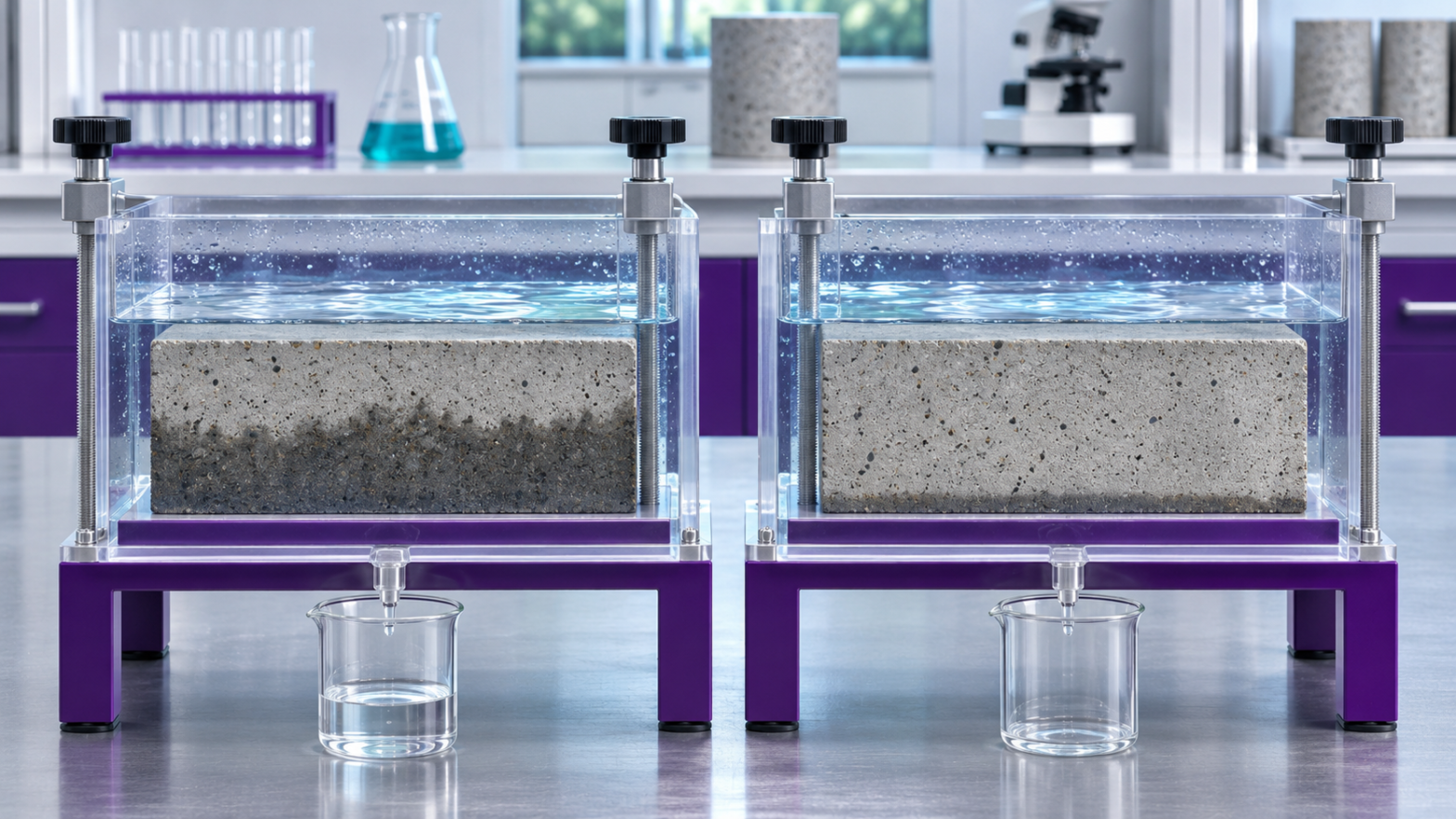
Proprietary waterproof concrete systems can offer genuine value. Their contribution may extend beyond an admixture to mix requirements, design input, joints and penetrations, site inspection, quality assurance and a commercial warranty.
That wider service should not be overlooked. However, when improved permeability or resistance to water penetration is attributed to the concrete admixture itself, the comparative evidence needs careful reading.
Water/cement ratio changes the comparison
Published assessments do not always compare concretes at the same water/cement ratio. If a control at a higher ratio is tested against a proprietary-system concrete at a substantially lower ratio, improved performance should be expected from established concrete technology alone.
Reducing the effective water/cement ratio—while maintaining workability and proper compaction—normally produces denser concrete with improved transport properties. The test may show that the complete proprietary mix performs well, but it may not isolate which part of the improvement comes from the specialist waterproofing component.
This is especially relevant where the product contains water-reducing functionality or is specified alongside a superplasticiser. Enabling workable concrete at a lower water/cement ratio is a valid benefit, but it should be described accurately.
Ask what the test proves
- Does the complete proprietary system produce concrete with suitable water resistance?
- How much improvement results from the revised water/cement ratio and mix design?
- What additional benefit is demonstrated by the waterproofing mechanism itself?
Answering the first question does not necessarily answer the other two.
Concrete is only part of watertight construction
No admixture removes the need for suitable structural design, crack control, workmanship and properly detailed joints. Penetrations, waterstops, construction sequencing and curing can be as important as the concrete formulation.
A better basis for selection
- Are control and test concretes using comparable water/cement ratios?
- Are consistence, air content and compaction conditions comparable?
- What cementitious materials and total binder content are used?
- How were specimens conditioned and variability reported?
- What site quality requirements and warranty limitations apply?
Independent scrutiny helps separate product performance, mix-design effects and the value of the wider system. B-TEK can support producers, designers and clients with mix reviews, comparative evidence and practical concrete technology advice.